
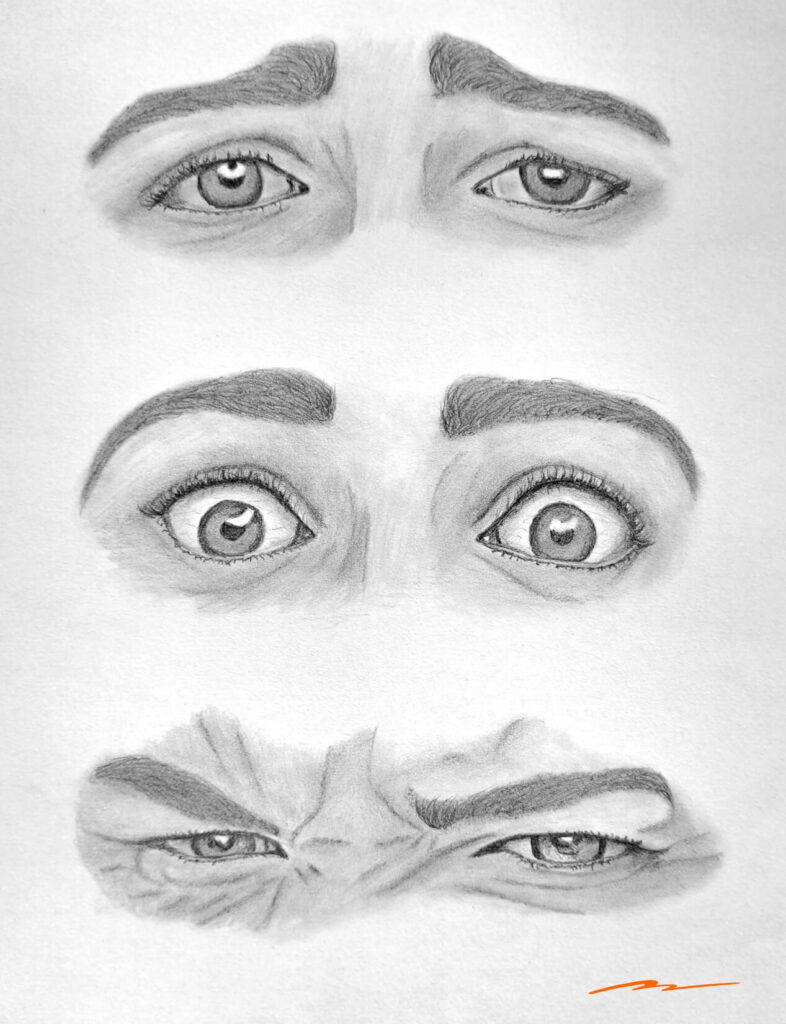
The eyes can change dramatically without changing their basic shape.
A slightly raised upper lid can turn an ordinary gaze into surprise, while a small shift in the eyebrows can make the same eyes look worried, angry, or sad.
What’s even more interesting is that you don’t need to redesign the entire eye for every emotion. Instead, pay attention to the relationship between the eyebrows, eyelids, iris, and the amount of visible white around the eye.
Facial expression research supports this idea. Scientists who study facial movement often describe expressions using individual movements called Action Units.
Several of these movements involve the brows and eyelids, and their combinations help distinguish expressions such as fear, surprise, sadness, anger, and happiness.
There’s an important catch, though. An expression isn’t a rigid formula, and eyes alone don’t give the whole picture. This is because people don’t all make exactly the same face when they’re sad, surprised, or confused.
That said, let’s learn how to draw the 9 most common eye impressions that show what the subject is feeling.
Part 1: Sad, Scared, and Disgusted Eyes
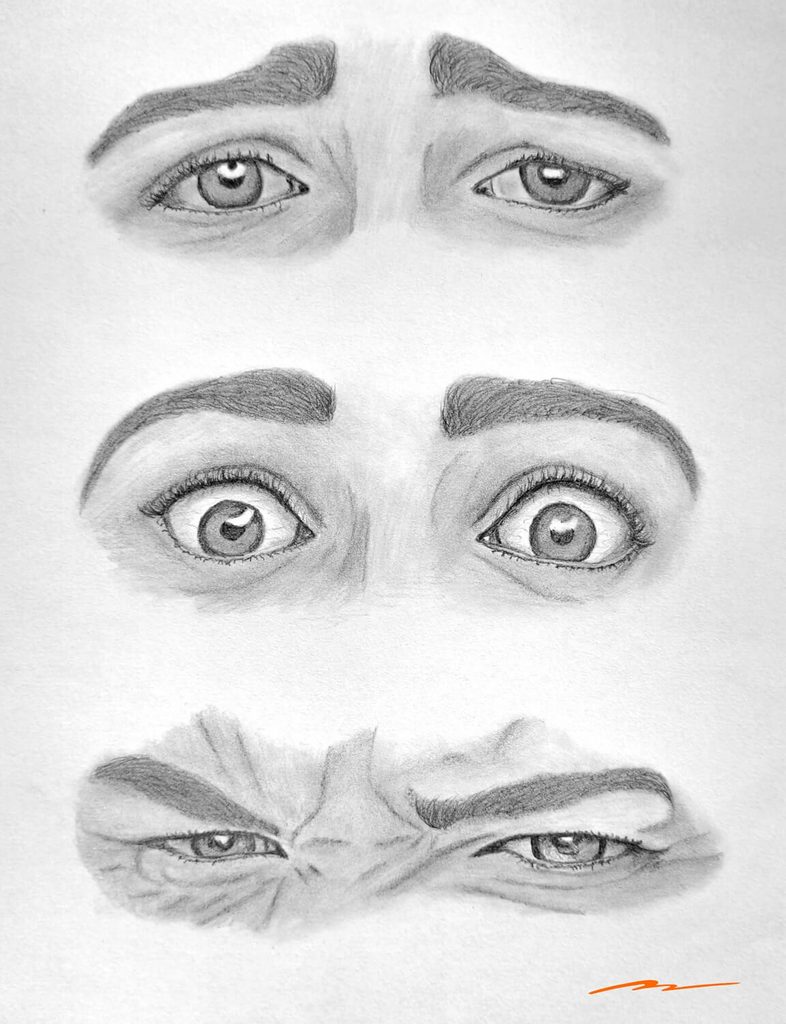
For the first group, the differences can be surprisingly subtle. Sadness and fear can both pull the eyebrows into unusual positions; for example, while disgust depends more heavily on what happens around the nose and mouth.
Sad Eyes
Sadness often shows strongly around the inner part of the eyebrows. The inner brow tends to lift while the area between the eyebrows can draw together, giving the upper face a strained or upward-pulled appearance.
For a sad eye drawing, start by changing the eyebrow rather than dramatically changing the eyeball. Raise the inner end of the brow and let the upper eyelid respond naturally beneath it.
The lower eyelid can also look slightly fuller or more tense. Depending on the intensity of the expression, the eyes may appear moist or narrowed, but you don’t need to exaggerate this to communicate sadness.
One useful trick is to compare the two sides of the face. Real expressions aren’t always perfectly symmetrical, so a tiny difference between the eyebrows can make the drawing feel much more believable.
Scared Eyes
Fear is one of the expressions where the eyes really do become the main event. The upper eyelids lift, the eyebrows rise, and more of the eyeball becomes visible.
When drawing scared eyes, open the eye vertically rather than simply making the entire eye larger. Raise the upper eyelid and eyebrow, then expose more of the sclera, especially around the upper and sometimes lower edges of the iris.
Be careful with the iris. If you make it dramatically smaller while enlarging the eye, the expression can quickly become cartoonish. A frightened person can have wide eyes without looking like they’re staring through dinner plates.
Fear and surprise are especially easy to confuse because both can involve raised brows and wide eyes. The difference usually comes from the rest of the face and the particular combination and intensity of the movements.
Disgusted Eyes
Disgust is an interesting one because the eyes often play a supporting role. The expression commonly involves wrinkling around the nose, raising the upper lip, and changes to the eyebrows and eyelids.
For an eye-focused drawing, bring the brow slightly downward and inward and allow the upper eyelid to look more compressed. The lower eyelid may also appear tighter.
The key is restraint. If you draw only a heavily furrowed brow, the result may look angry rather than disgusted. The surrounding facial muscles give disgust much of its identity, so the eyes should work with the nose and mouth rather than trying to carry the entire expression.
That distinction matters when you’re drawing from a reference. If the eyes look ambiguous on their own, don’t force them into a stereotypical expression. Study the whole face and let the surrounding features guide you.
Part 2: Confused, Playful, and Calm Eyes
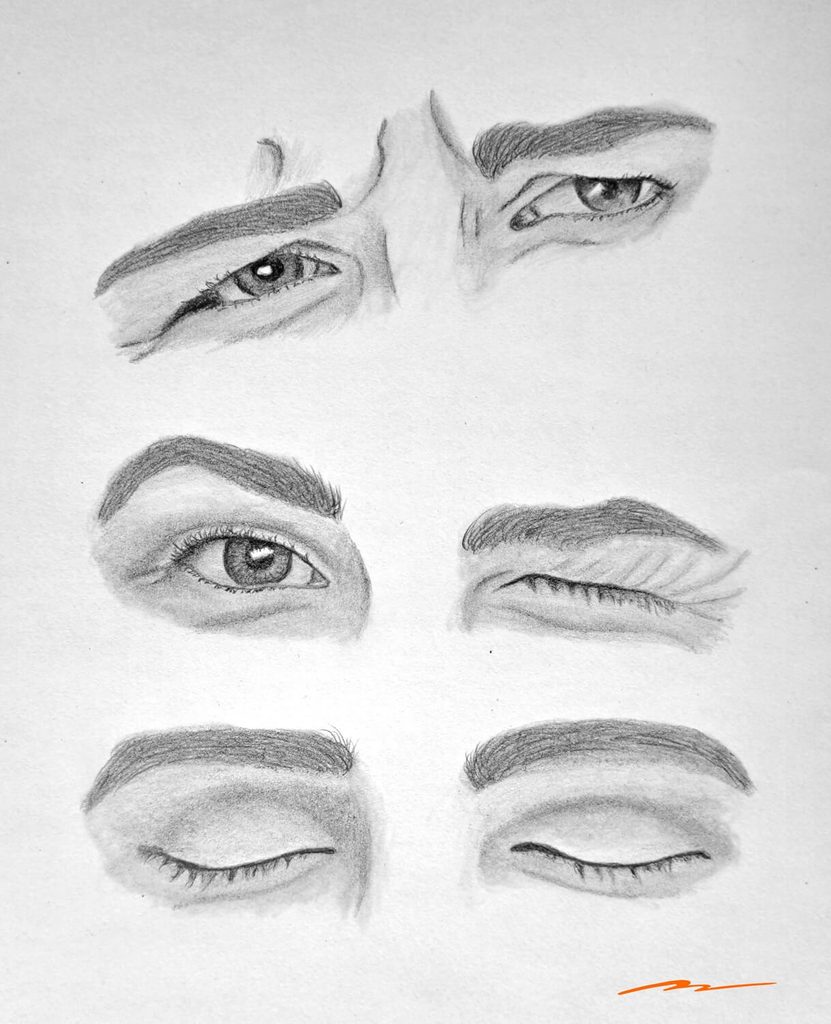
The second group shows how much expression can come from relatively small changes. Confusion may involve an uneven brow, playfulness can come from a lowered or narrowed gaze, and calmness may require surprisingly little information at all.
Confused Eyes
Confusion often looks less symmetrical than the expressions we’ve covered so far. One eyebrow may rise while the other stays lower or draws inward.
That asymmetry is useful when drawing confused eyes. Try raising one eyebrow and slightly tightening the other side rather than making both eyebrows perform the same movement.
The eyes themselves can remain fairly close to their normal shape. A slightly uneven eyelid position and a wandering or questioning gaze can do more for the expression than dramatically enlarging or shrinking the eyes.
If your confused expression looks angry, check the eyebrows first. Heavy downward pressure from both brows tends to push the drawing toward anger, while an uneven brow arrangement gives you more of that questioning quality.
Playful Eyes
Playfulness is harder to pin down because it’s often communicated through the combination of the eyes, eyebrows, mouth, and head position.
For a playful eye drawing, try a slightly narrowed upper eyelid with a relaxed lower eyelid. The eyebrows can be raised unevenly or given a slight arch, depending on the character you’re drawing.
A sideways gaze can also make the expression feel more mischievous. The important thing is where the iris and pupil are looking, not simply how large the eyes are.
This is a good place to remember that expression isn’t only about anatomy. Direction of gaze changes the apparent attitude of a face. The same pair of eyes can look innocent when looking directly at you and mischievous when looking sideways.
Calm Eyes
Calmness can be represented with relaxed, closed eyes. Here, the drawing challenge changes because you aren’t really drawing the eyeball at all. You’re drawing the form of the eyelids over it.
When the eyes close naturally, the upper eyelid travels downward and the visible opening becomes a curved line. Avoid drawing a perfectly symmetrical almond shape and filling it in. The eyelid has thickness and sits over a rounded eyeball, so its contour should follow the underlying form.
For a restful expression, keep the eyelid curve soft. The eyebrows should also remain relaxed rather than sharply raised, lowered, or squeezed together.
One useful observation is that closed eyelids aren’t simply two lines drawn across the eyes. Look at photographs of people with their eyes gently closed and you’ll notice subtle folds and changes in the skin around the eye.
Part 3: Surprised, Happy, and Angry Eye Drawing
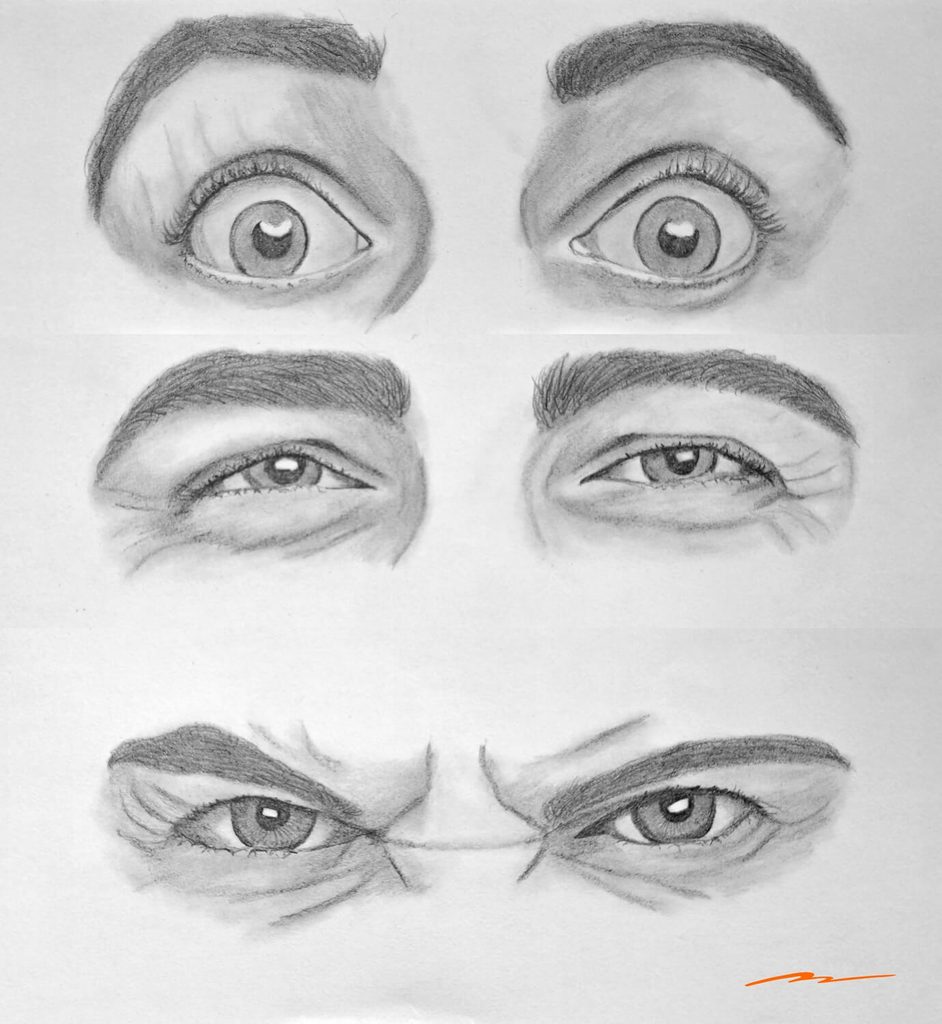
The final three expressions are particularly useful to practise because they’re visually distinct. Surprise opens the eyes, happiness activates the muscles around them, and anger compresses and tightens the area.
Surprised Eyes
Surprise usually involves raised eyebrows and raised upper eyelids. The eyes appear larger because more of the sclera becomes visible above the iris, while the eyebrows move noticeably upward.
When drawing surprised eyes, first raise the eyebrows. Then lift the upper eyelids to reveal more of the eye.
That order can help. If you simply draw enormous eyes without changing the eyebrows, the result may look startled or cartoonish rather than genuinely surprised.
Look carefully at the forehead as well. Raised eyebrows create space between the brows and the eyes, and the forehead may develop horizontal wrinkles. Even in an eye-focused drawing, those surrounding lines help sell the expression.
Surprise can resemble fear, which is why these two expressions deserve careful comparison. Both can involve wide eyes and raised brows. Fear tends to introduce more tension, particularly around the brows and eyelids, while surprise can have a more open, lifted quality.
Happy Eyes
People often draw a smile and leave the eyes almost untouched. That’s a missed opportunity.
A genuine happy expression usually involves the cheeks lifting and the muscles around the eyes becoming active. This can produce small wrinkles or folds at the outer corners of the eyes, sometimes called crow’s feet.
For a happy eye drawing, gently raise the cheeks by allowing the lower eyelid to lift. The lower edge of the eye may become flatter or more curved upward, while the upper eyelid can appear slightly narrowed.
Don’t simply add a few wrinkles beside the eye and call it happiness. The wrinkles should follow the movement of the surrounding skin. Think of them as evidence of the underlying movement rather than decoration.
The distinction is important because research on facial expressions has found that happiness is strongly associated with movement around the cheeks and eyes, often referred to as the Duchenne marker. The eyes therefore help make a smile look engaged rather than merely posed.
Angry Eyes
Anger compresses the area around the eyes. The eyebrows generally move downward and inward, creating a stronger crease between them, while the eyelids can become tense or narrowed.
To draw angry eyes, start with the eyebrows. Lower the inner ends and bring them closer together. Then tighten the eyelids underneath them.
The upper eyelid may look heavier, and the lower eyelid can become more pronounced as the muscles around the eye tighten. Keep the iris and pupil relatively normal unless the reference suggests otherwise.
One common mistake is making angry eyes enormous and round. That tends to move the expression toward fear or surprise. Anger usually feels more compressed, focused, and tense.
The eyebrows are doing a lot of work here. In facial-action research, brow lowering is strongly associated with anger, while eyelid tightening can add to the intensity.
If you enjoyed today’s guide, here are more interesting tutorials just like this one:
Conclusion
Good eye expression drawing comes down to movement. The eyeball itself doesn’t suddenly become sad, angry, playful, or surprised. The surrounding structures change their position, tension, and relationship to one another.
Start with the eyebrows and eyelids, then check the iris, visible sclera, and folds around the eyes. After that, bring in the rest of the face when the expression needs it.
The more you study those small changes, the less you’ll need to rely on exaggerated cartoon cues.
A few millimeters of movement can completely change the character of a face, and that’s exactly what makes eyes so rewarding to draw.