
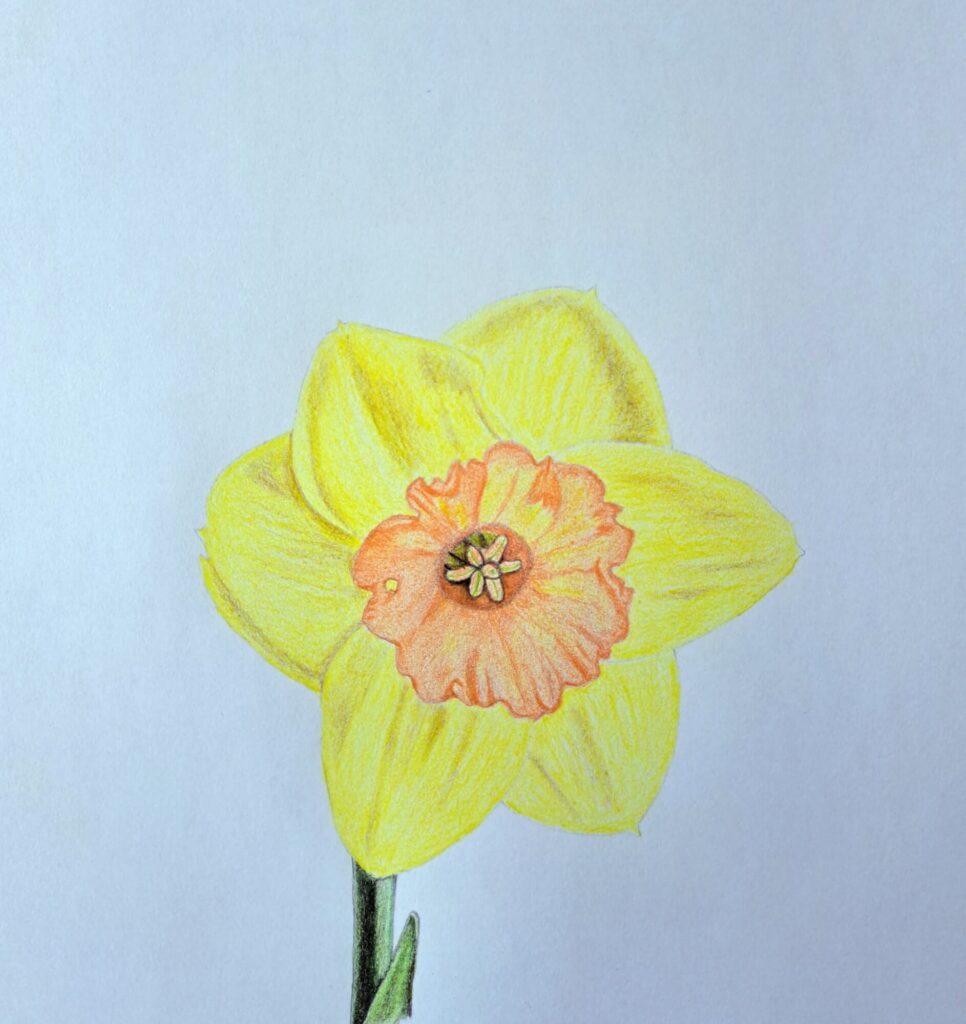
Daffodils are symbols of renewal, resilience, and hope. In many cultures, they mark the end of winter and the quiet promise that brighter days are coming.
In fact, most Cancer societies even use the daffodil as a symbol of hope during their Daffodil Days campaign, which speaks to the emotional weight this flower carries.
So, next time you come across these special flowers, stop for a moment to reflect and, if you can, make a small donation to a cancer society of your choice.
Today, I’m excited to sketch and discuss how to draw a daffodil with color pencils as I continue updating my series on drawing flowers.
Let’s get to it step by step.
Drawing a Colored Daffodil in 5 Easy Steps
Basic Sketching of a Daffodil
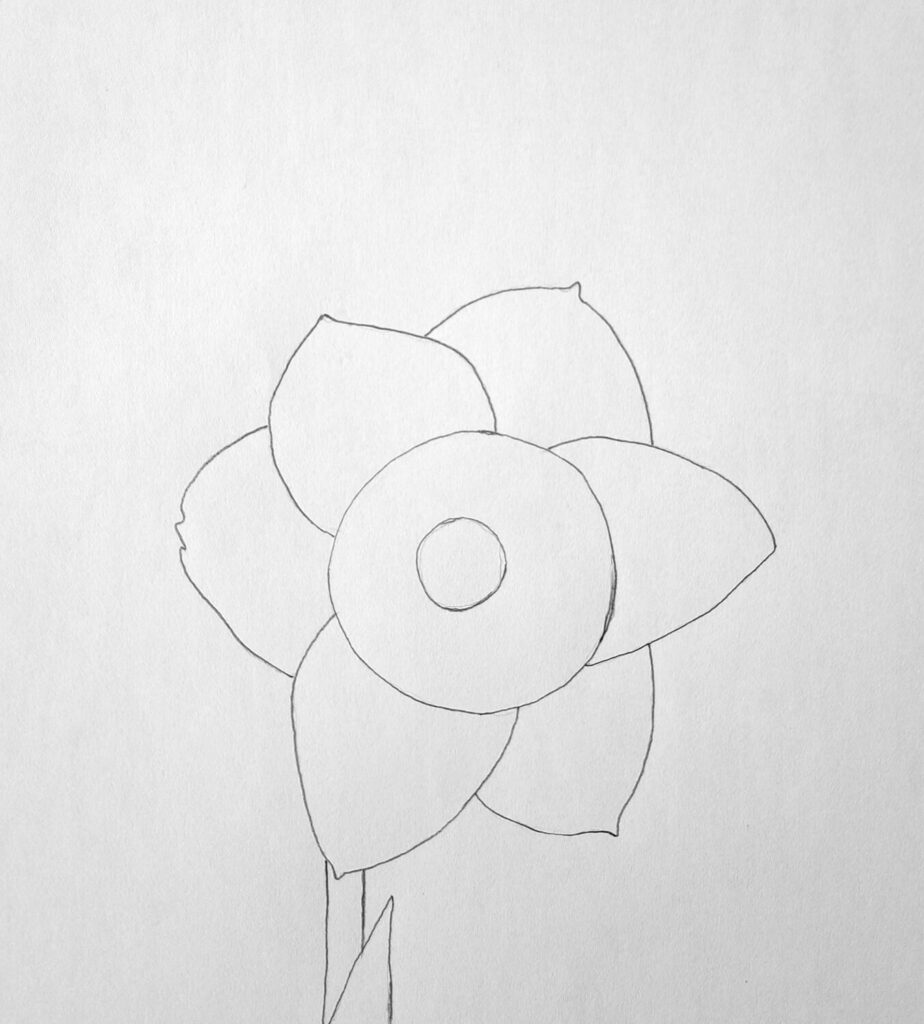
A daffodil has two main parts, the outer petals and the central trumpet, also called the corona. Botanically, daffodils belong to the genus Narcissus, and most have six petal-like tepals arranged around that trumpet center.
Start with a light circle to mark the face of the flower. Then draw a smaller circle inside it for the trumpet opening, which resembles a donut sitting in the middle of a plate.
Next, divide the outer circle into six rough sections. These will guide the petals. They don’t need to be perfect.
Then sketch the petals. They’re slightly pointed at the tips and a bit wavy along the edges. You should let some overlap subtly. Real daffodils aren’t evenly spaced like spokes on a wheel.
Finally, draw a long and slightly slender stem. Add one or two narrow leaves that arc upward. In my case, I’ve just done one, but remember to always keep the lines light.
Complete, Detailed Sketch
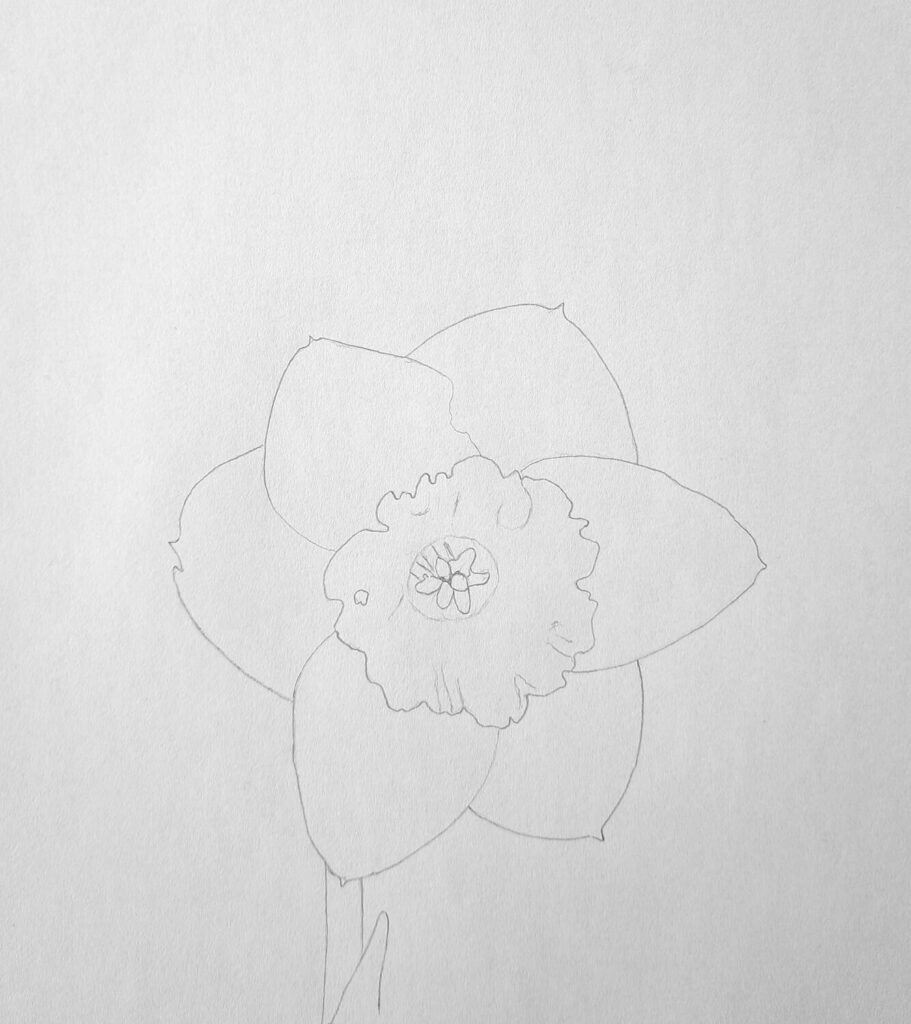
For the trumpet, try to extend a short cylinder from the inner circle. However, it won’t be visible in some instances when the trumpet is facing in front (at this stage).
You also need to add a slightly ruffled edge to that rim.
Inside the trumpet, sketch the pistil and the stamens. At this stage, the drawing should already feel dimensional, even without color.
Base Coloring (First Layer)
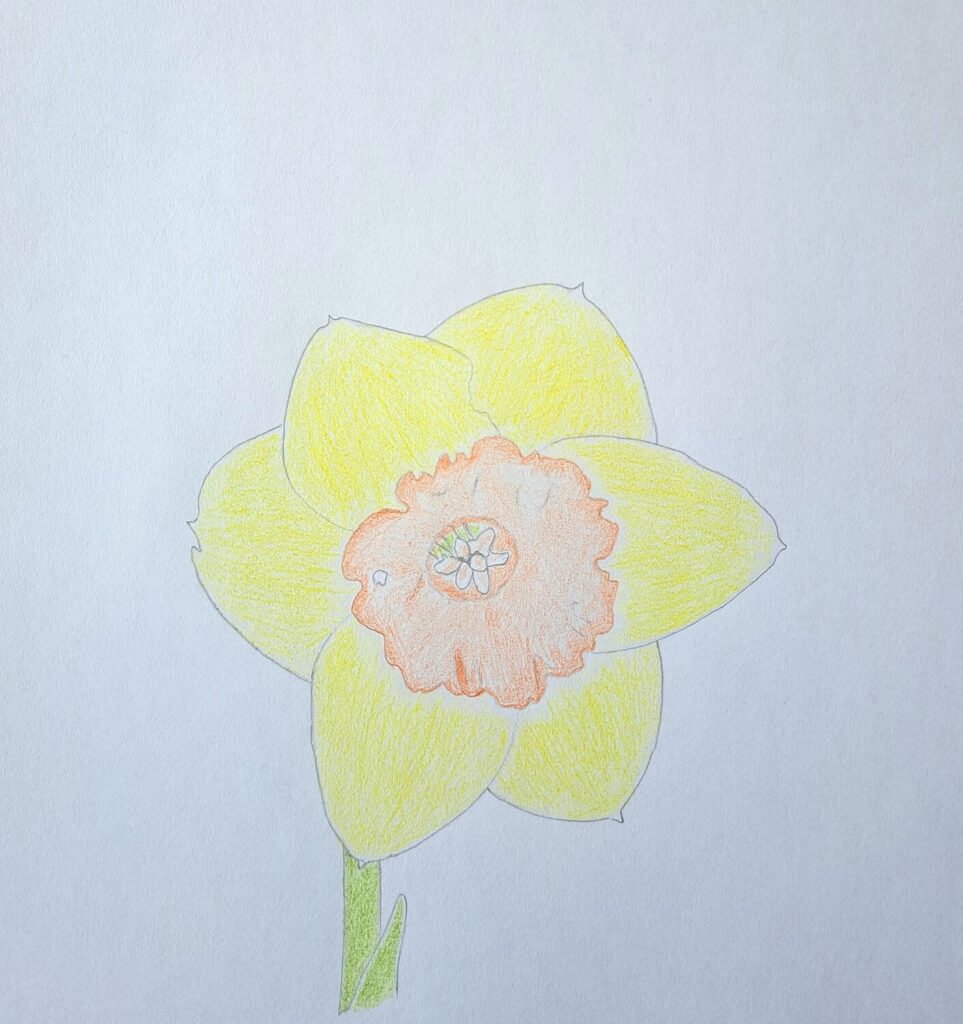
The first step is to apply a uniform color across the sketch. To do that, use a yellow-colored pencil, and with light pressure, lay down a smooth, even layer across all the petals.
You can use small circular motions to avoid streaks.
For the trumpet, choose a light orange or golden yellow-orange. Again, soft pressure. The stem and leaves get a light green base. I usually pick a slightly warm green first. Cool greens can come later.
It’s important to remember that building color gradually preserves luminosity and prevents surface burnishing too early. Once you press too hard, you flatten the tooth of the paper. And then blending becomes harder.
Deepening Colors and Transitions
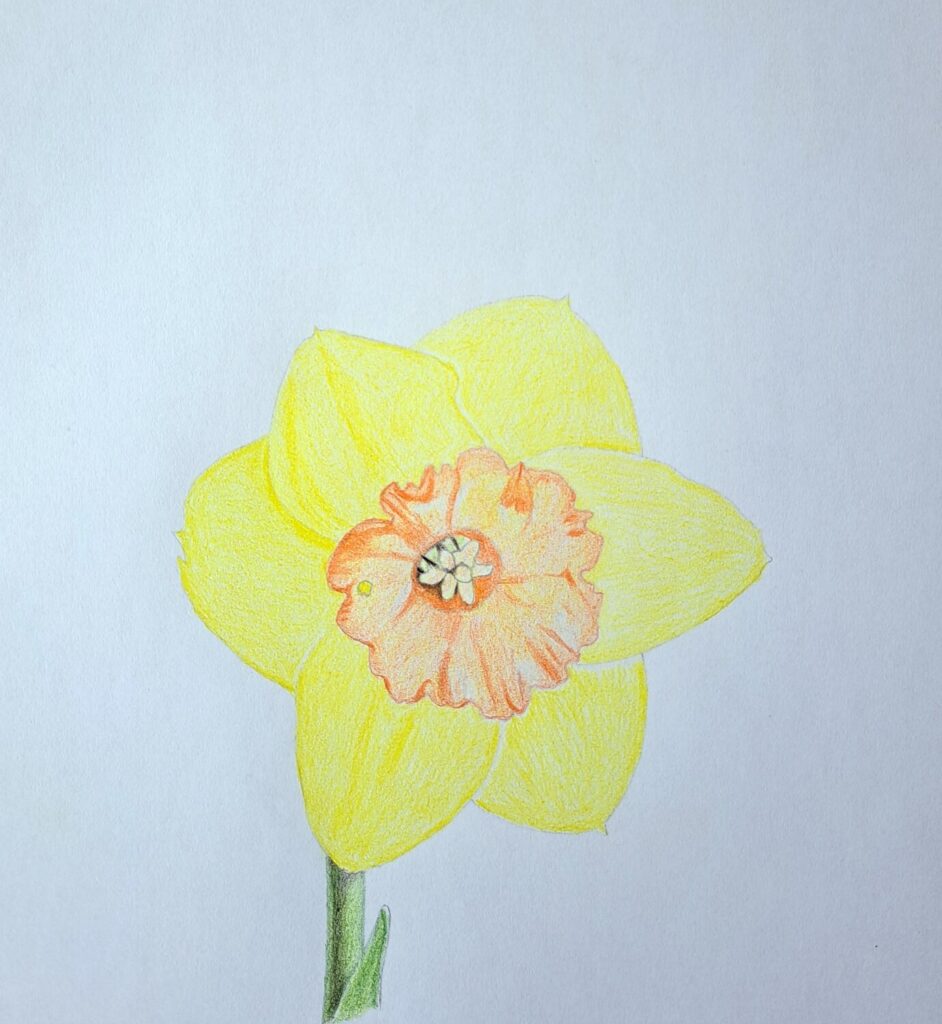
At this point, I have to mention that most colored pencils are transparent, so dark graphite will often show through. To prevent this, I used a kneaded eraser to completely erase the flower outline before proceeding with further coloring.
You can begin by darkening the inner opening slightly to show that it recedes inward. Use a black pencil in combination with a dark orange, as shown in my diagram.
Then return to the petals with a slightly darker yellow. Near the base of each petal, where it meets the trumpet, layer more color. That area naturally sits in a slight shadow.
For the trumpet, you can intensify the inner rim by using a deeper orange and apply it inside the flared edge and around the inner opening.
For the stem, add a darker green along one side, usually the shadow side.
Detailed Coloring, Shadows, and Highlights
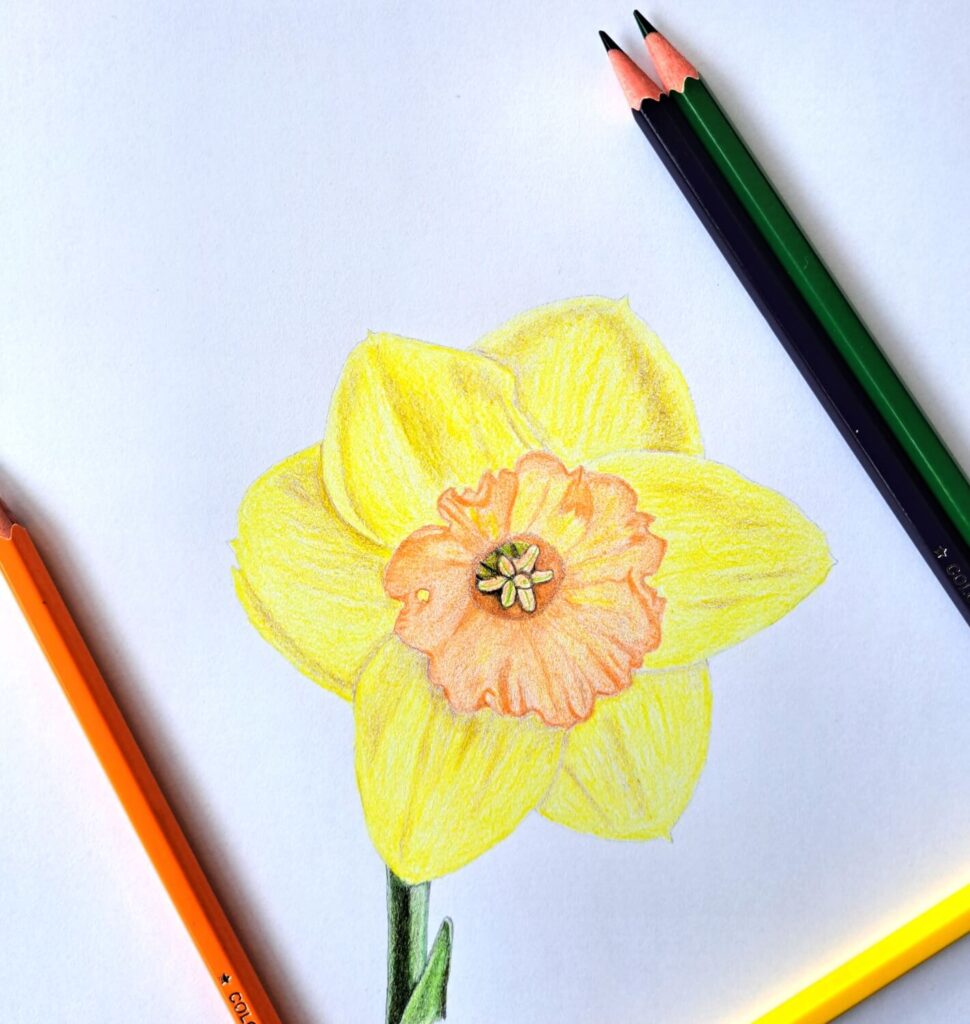
As we come to a close, there’s one myth I’d like to clarify about pencils range. You don’t need a set of 24 expensive colored pencils to produce a remarkable piece.
If you only have one yellow pencil, you can vary the pressure on your hand to produce various shades ranging from light to dark, as I do. Needless to mention, for this daffodil drawing, I only used 4 colored pencils as shown above.
If you observe closely, the dark one is actually purple, and I’ll explain how important it is to have it in your repertoire, especially when working with yellow colors.
For the last and final step, observe the petals, trumpet, and the stem, paying attention to the light and shadows.
Usually, it’s lighter along the outer edges and raised ridges on the petals. If you’re not sure, refer to a reference photo. Once sure, you can gently burnish those areas with a very light yellow, an eraser, or even a cream pencil (if you have it).
For deeper shadows, the purple comes in handy in the darkest yellow shadows. If you decide to use any other color, it could easily overpower and replace the existing yellow.
You can darken inside the trumpet with a mix of deep orange and a hint of red to create warmth. Then blend outward so it transitions smoothly into the lighter orange.
Finally, lift pigment carefully with a kneaded eraser or use a white colored pencil very lightly to create highlights on the petals.
At this point, you should be proud of the outcome.
In case you’d like more tutorials on floral drawings, here are my top 5 recommendations:
- How to draw an orchid flower
- Drawing a rose
- How to draw cosmos flowers
- Lily flower drawing
- How to draw a peony
Conclusion
Daffodils are one of the most welcoming signs of spring. But more than that, they resemble hope and better days ahead.
While I could have done my usual to draw them using graphite pencils, I just couldn’t avoid the temptation of rendering this piece in color. I had to respect that vibrant color that means so much to humanity.
I hope you’ve been inspired not just take me up on this challenge but to remember and support those fighting cancer.
As always, don’t forget to spread the word by sharing this article on Facebook or save on Pinterest. I appreciate you!