
The right pair of glasses can be a fashion statement, as well as a practical means of protecting your eyes when the sun is shining or improving vision.
Ideally, the choice of glasses should reflect someone’s personality and mesh nicely with the rest of their look.
For portrait artists, understanding how to draw this vital accessory is a must.
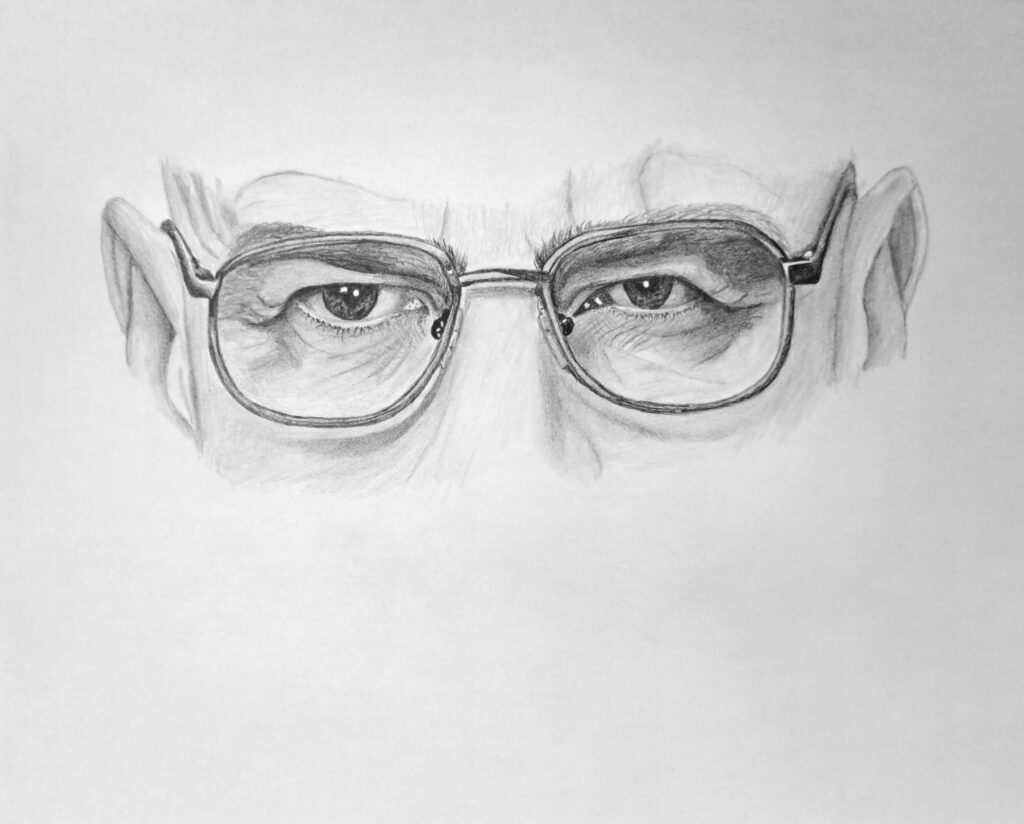
In today’s tutorial, you’ll learn how to draw glasses using graphite pencils, including a real portrait of Walter White from Breaking Bad with his iconic look in glasses.
Simple Steps for Drawing Glasses
Sketch the Shape of Lenses
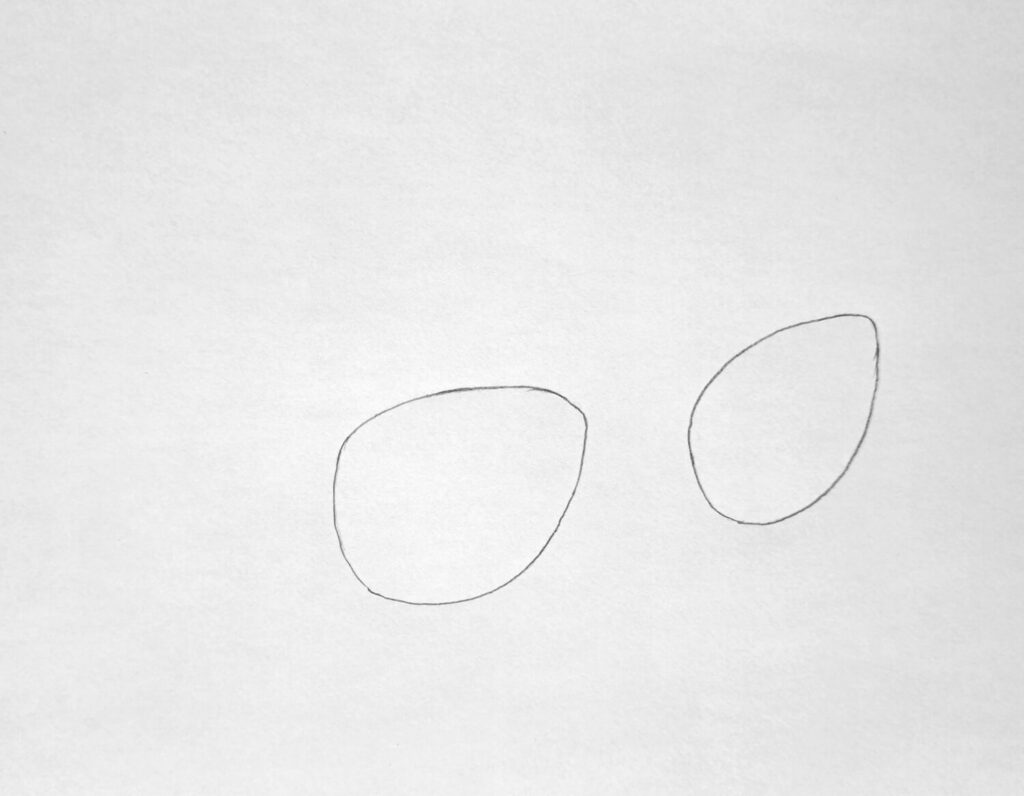
I always find it easier to ignore the frame at first and focus only on the lenses.
If their sizes, angles, or spacing feel wrong, everything built on top tends to inherit those problems. Keep your lines light.
Try to look at the empty spaces as much as the actual shapes. Notice the gap between the lenses. Notice whether one lens appears narrower because of perspective. If the head turns slightly, the lens farther away often appears compressed and smaller.
Sketch the Frame and Temples
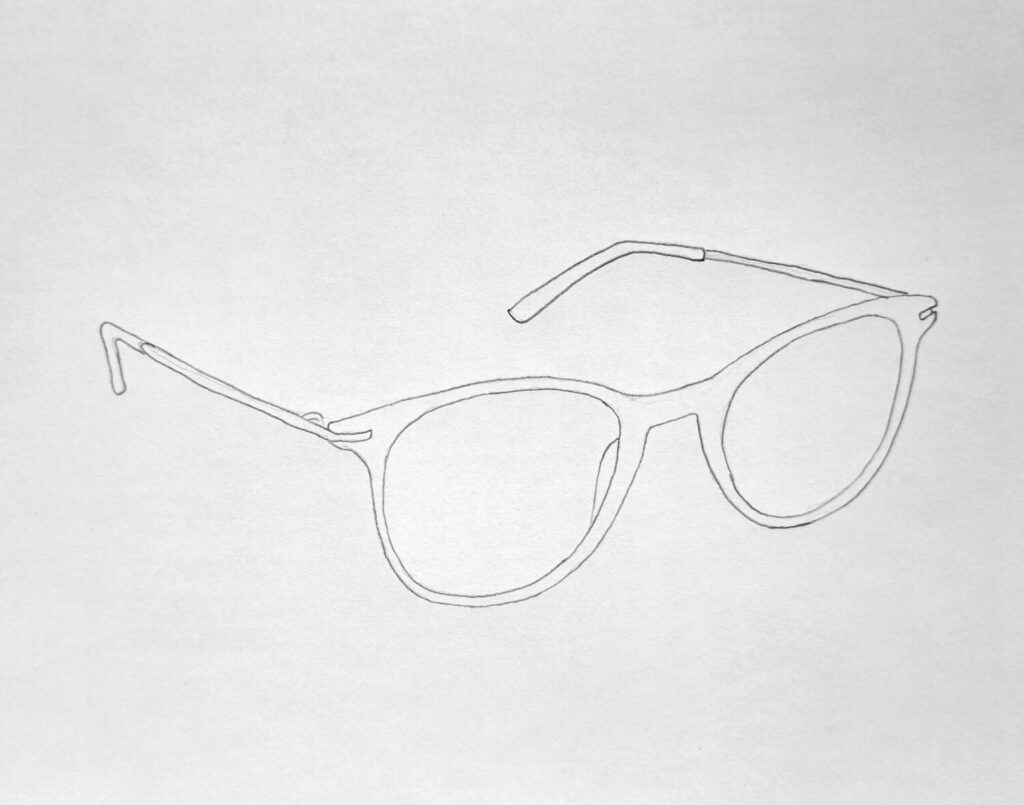
Once the lens placement looks convincing, start building the frame around it.
A common habit is drawing the frame as a single dark outline wrapped around the lens. Real frames have thickness.
The bridge should feel like it travels forward before wrapping toward the face. The temples should recede naturally instead of shooting straight backward. Even tiny details like the hinges create depth because they interrupt smooth surfaces and create overlapping forms.
Complete the 3D Sketch by Drawing the Details
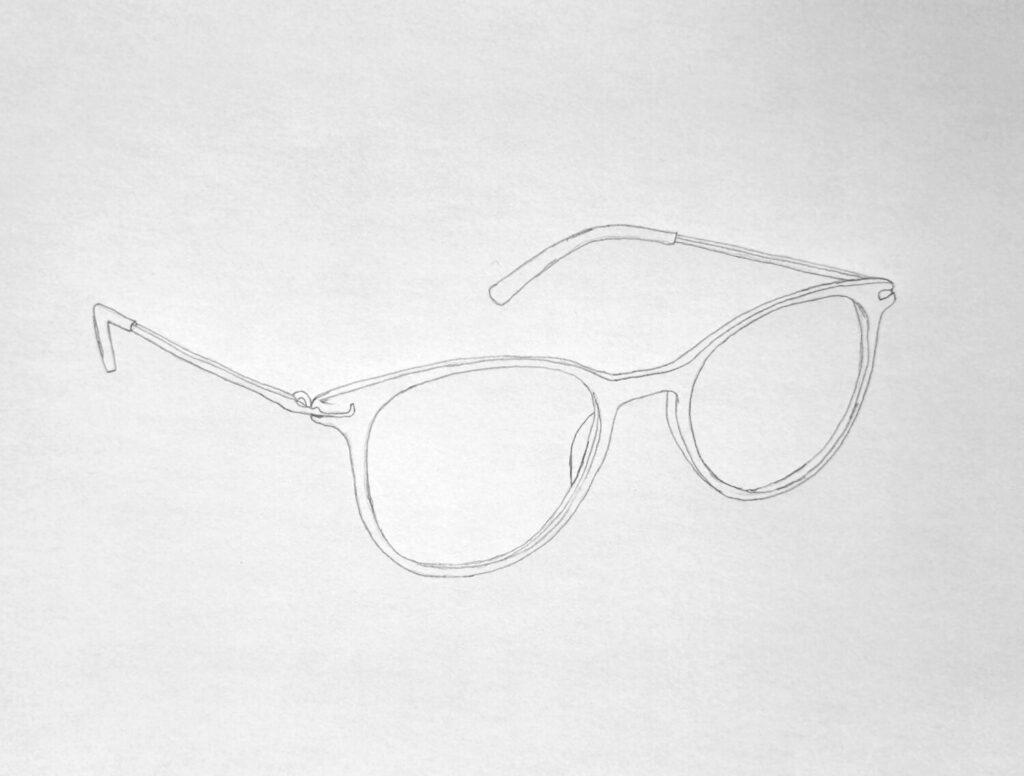
If you pay close attention to my drawing above, you’ll notice that even without shading, my glass sketch already appears 3-dimensional. You can observe the frame from three sides, i.e., the side, top, and bottom.
This is achieved by refining the thickness of the rims, defining the nose pads, and introducing subtle curves where the frame wraps around the face.
Shade the Darks on the Frame and End Pieces
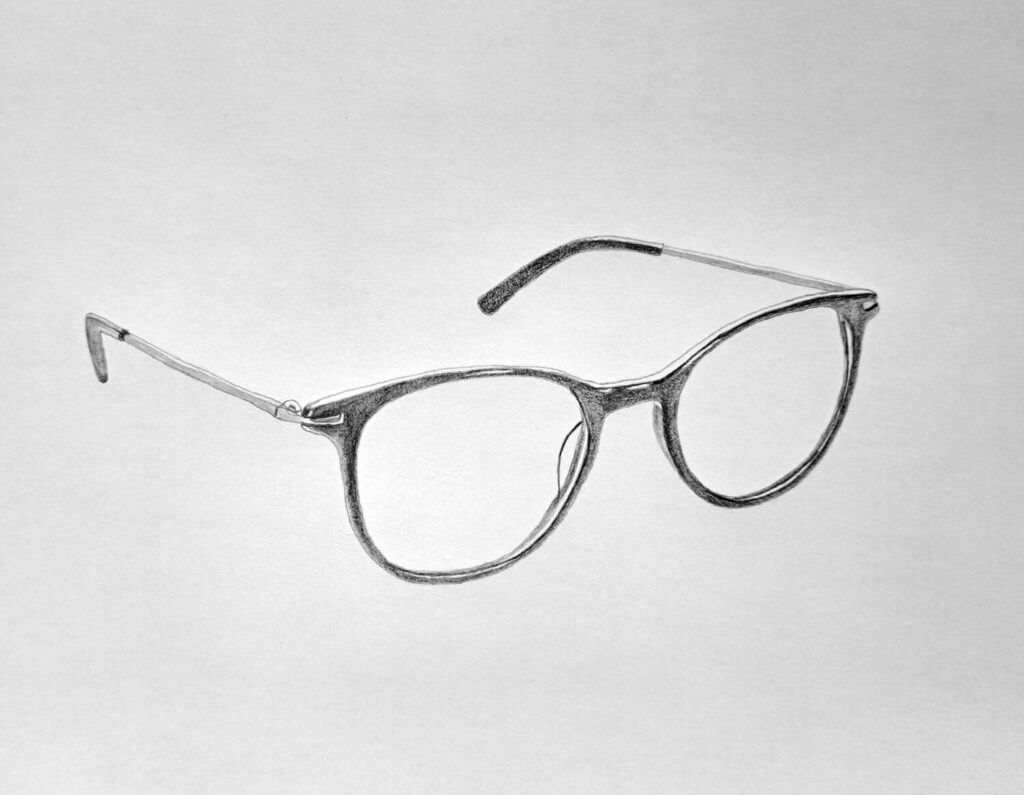
Begin by shading all the dark areas using a 2B pencil. Look for the places where the frame overlaps itself, where the temples connect, and where shadows collect underneath the structure.
Also, shade the end pieces connected to the frame by the temples. You can shade temples lightly using an HB pencil.
In this step, the key is to avoid block shading and instead leave other areas unshaded to create the illusion of reflection.
Complete with Midtones and Highlights
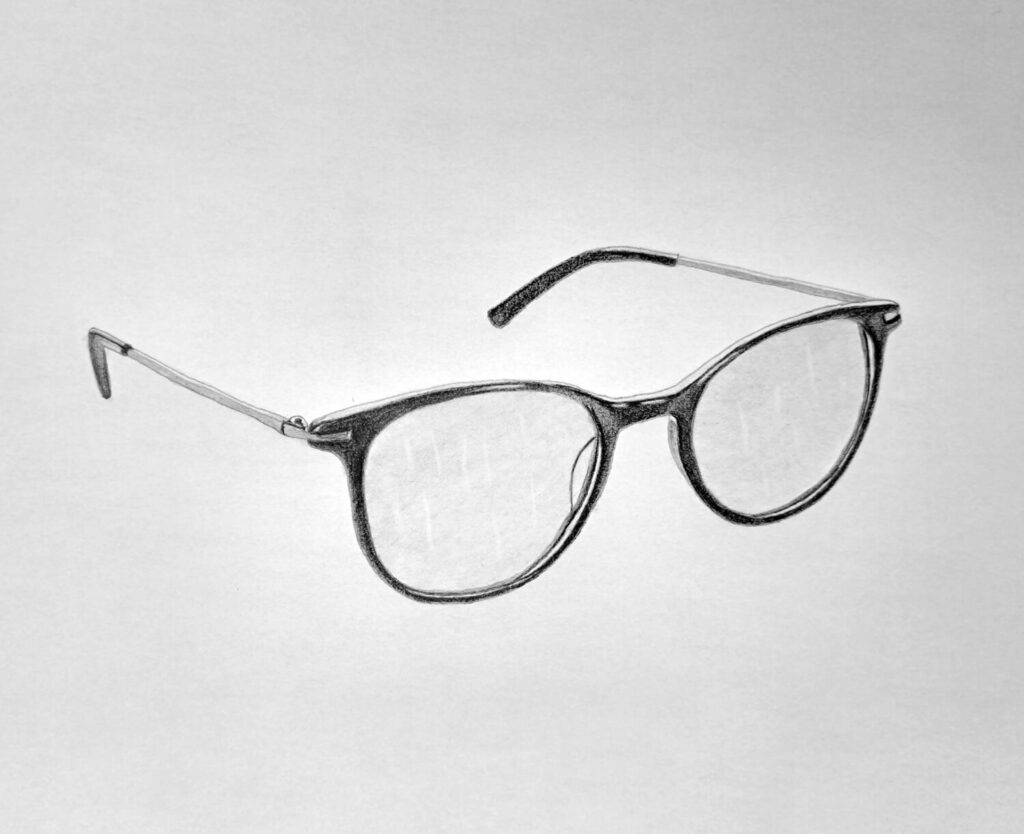
Remember, in the previous step, we left some areas completely unshaded. Now we can use an HB pencil and lightly shade all those areas as shown in the illustration above.
Besides, since the lens isn’t completely transparent, you can use a hard, soft pencil, preferably H, to uniformly shade across the lens. Once you’re satisfied, use a kneadable eraser to create slight marks along the lenses for realism.
At this point, you may have a complete drawing of glasses. But before we continue, I have made several observations when drawing different types of glasses as follows:
- These steps apply to any type of glasses.
- Some lenses create subtle reflection while others are completely transparent.
- Don’t create reflections where there are none and vice versa (In short, use a reference if you’re after realism).
Application: Drawing Walter White’s Sunglasses
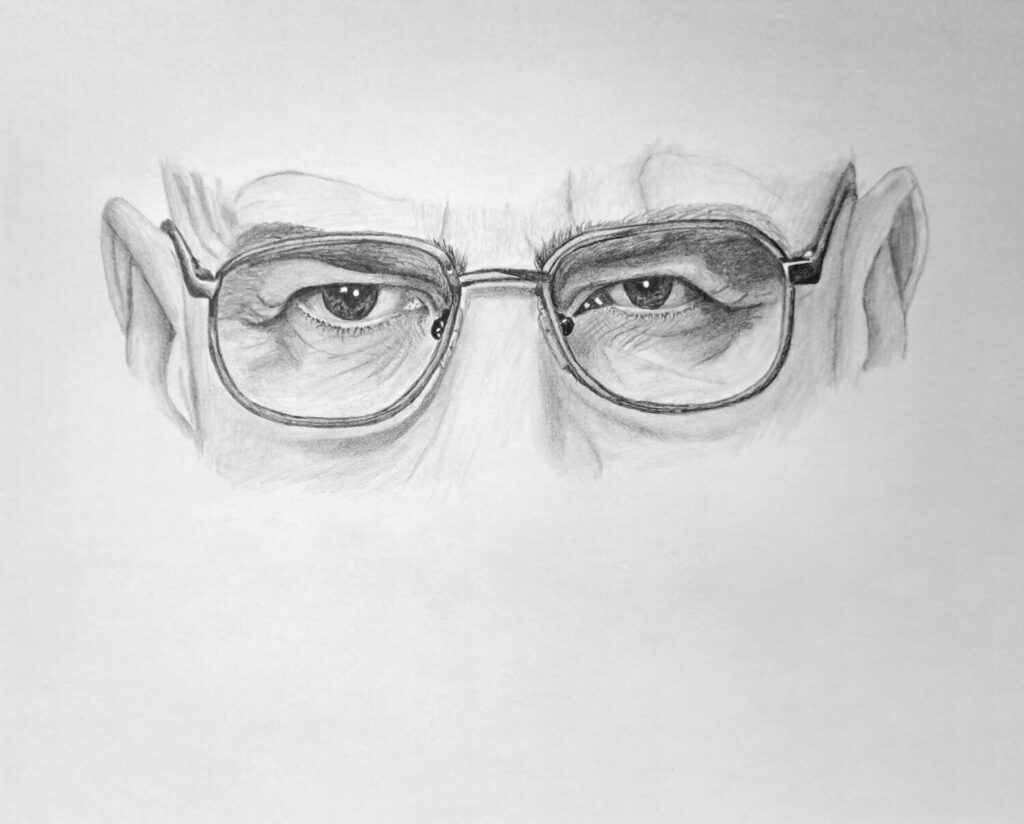
Just like most people I know, I’m an avid consumer of movies and interesting series. But my greatest show of all time is Breaking Bad, starring Bryan Cranston as Walter White, also known by his alias Heisenberg.
His character isn’t complete without his iconic glasses.
That’s why, when I was thinking of a figure to portray as an application for this tutorial, I couldn’t resist drawing him.
Even though Walter White’s portrait is only partially complete (showing the areas around the eyes), many fans would easily recognize him. I’m not sure if the same could be true without the glasses.
That’s the power of glasses in creating a persona.
If you enjoyed this guide, also check out the following:
- How to draw a light bulb.
- How to draw a wine glass.
- How to shade an ice cube.
- How to draw a photorealistic glass of water.
Conclusion
You’ve learned how to draw any type of glasses. Now, next time you’re attempting to draw a portrait of someone wearing sunglasses, it won’t be as intimidating.
Remember to also check the other suggested tutorials to keep learning and honing your craft. It doesn’t matter whether you’re a hobby artist like me, a beginner, or a professional artist; practice is the one thing we can’t get enough of.
Have you been inspired to keep drawing? I hope so.